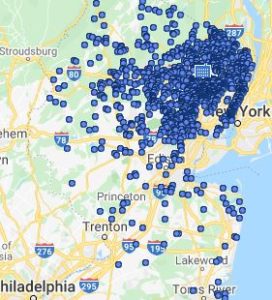



I’ve performed well over 150 home inspections in Jersey City since 1993. Our Jersey City home inspection clients should have confidence when hiring me — odds are I have been in that neighborhood, often on that very street, and I will have additional knowledge I will share with you that less experienced home inspectors simply do not have.
Jersey City has many very old homes, some newer homes, and recently a major construction surge in high-rise buildings. Old homes — especially those with extensive renovations — present quite the challenge to many inspectors because there are just not that many of them in existence in other areas of New Jersey.
Major renovations on old homes often cause as many problems as they solve when structural members that literally hold the house up get cut by contractors who either do not understand old homes or simply wish to get the job done faster.
What Makes Jersey City Different to Inspect
Jersey City is Hudson County’s largest city and one of the most densely developed municipalities in New Jersey. The housing stock reflects more than a century of urban construction — pre-war row houses and brownstones in the Heights and Bergen-Lafayette neighborhoods, mid-century apartment buildings and two-families throughout the city, and a wave of newer condo construction along the waterfront that continues today. Each era presents its own specific inspection challenges.
Buyers come to Jersey City for the PATH access, the waterfront views, and the value relative to Manhattan and Hoboken. What they need to understand is that many of the homes that offer the best value are also the oldest — and the oldest homes in Jersey City carry a century of accumulated systems, modifications, and deferred maintenance that a thorough inspection needs to document accurately.
Electrical Systems in Older Jersey City Homes
In Jersey City’s pre-war row houses and brownstones — particularly in the Heights, Greenville, and Bergen-Lafayette neighborhoods — knob-and-tube wiring is a consistent finding. It may be the original system, still in service. It may be partially updated, with newer wiring added over decades by multiple owners with varying skill levels. In either case, improperly modified knob-and-tube systems are a documented safety hazard, and many homeowners’ insurance carriers will not extend coverage without requiring full rewiring.
In buildings from the 1965–1975 construction window — a period of significant apartment and multi-family development in Jersey City — aluminum branch circuit wiring is a common finding. Full remediation requires either complete rewiring or CO/ALR-rated devices at every connection point throughout the home.
Electrical panels in older Jersey City multi-unit buildings often serve multiple units from a single service entry, with individual unit panels of inadequate amperage for modern household demand. This is one of the first things I evaluate in any Jersey City multi-family or condo inspection.
Plumbing
In pre-1970 Jersey City homes, galvanized steel supply piping is the norm. At or past the end of its service life, galvanized steel corrodes from the inside — restricting flow, discoloring water, and eventually failing. Reduced water pressure at upper-floor fixtures in older Jersey City homes is almost always traceable to corroded galvanized lines.
Original cast iron drain stacks in pre-war Jersey City row houses are commonly 80 to 100 years old. A stack that looks intact from below may be paper-thin at the horizontal runs where corrosion accumulates. I note the age, visible condition, and any observable deterioration, and recommend evaluation by a licensed plumber when the evidence warrants it.
Structural Concerns in Row Houses and Brownstones
Row house construction in Jersey City’s older neighborhoods presents specific structural inspection challenges. These buildings share party walls with adjacent properties — meaning some structural elements are not fully accessible. I evaluate what is accessible and note limitations clearly.
Rear additions — extended kitchens, enclosed yards, rooftop decks — are extremely common in Jersey City row houses and are frequently constructed without permits and without the structural care of original construction. I specifically evaluate the junction between original construction and later additions, which is a consistent location for water intrusion, structural deficiencies, and electrical work of variable quality.
Parapet walls — the low masonry walls at the front and rear of flat-roofed row houses — are one of the most common findings in Jersey City inspections. Failed mortar joints, spalling brick, and deteriorated coping allow water to penetrate the masonry and migrate into the building. Parapet deterioration is not cosmetic; it is a water intrusion issue with real consequences for interior finishes and structural framing.
Water Intrusion
Water intrusion is the most consistent finding across all Jersey City property types. Flat and low-slope roofing on row houses requires regular maintenance and periodic replacement. Failed membrane seams, deteriorated flashings, and standing water are common. Below-grade and partially below-grade spaces in older row houses are prone to foundation wall seepage. I evaluate basement and lower-level conditions carefully and note when interior drainage systems indicate a property with a documented water history.
Lead Paint
Jersey City has one of the highest concentrations of pre-1940 housing in New Jersey. Homes built before 1978 may contain lead-based paint — and in pre-1940 construction, the probability is very high. New Jersey’s lead paint disclosure and inspection requirements apply, and buyers with young children should discuss lead paint testing with their attorney before closing. Lead paint testing can be coordinated at the time of your inspection appointment.
Condo and High-Rise Considerations
Jersey City’s waterfront development has produced a significant condo and high-rise market over the past two decades. Condo inspections cover the interior of the unit and systems within it — not the building’s common areas, exterior, roof, or shared systems. Buyers should request the building’s reserve study, maintenance history, and HOA financials before closing. A well-maintained building with a funded reserve is a fundamentally different purchase than one with deferred maintenance and an underfunded reserve.
Flood Zone Awareness
Portions of Jersey City — particularly the waterfront and areas near the Hackensack River and Newark Bay — are in FEMA-designated flood zones. Superstorm Sandy significantly affected parts of Jersey City in 2012. Buyers of properties in or near flood zones should verify flood zone designation, current flood insurance requirements and premiums, and any prior flood damage history before closing.
Schedule Your Jersey City Home Inspection
Call (973) 812-5100 between 8 AM and 8 PM on business days, or 8 AM to 5 PM on weekends. I serve all Jersey City neighborhoods including the Heights, Downtown, Journal Square, Bergen-Lafayette, Greenville, Bayfront, and the waterfront communities.
Accurate Inspections, Inc.
56 Woodland Drive, Woodland Park, NJ 07424
(973) 812-5100
Inspecting NJ Homes Since 1993 | NJ Licensed Home Inspector GI0121